
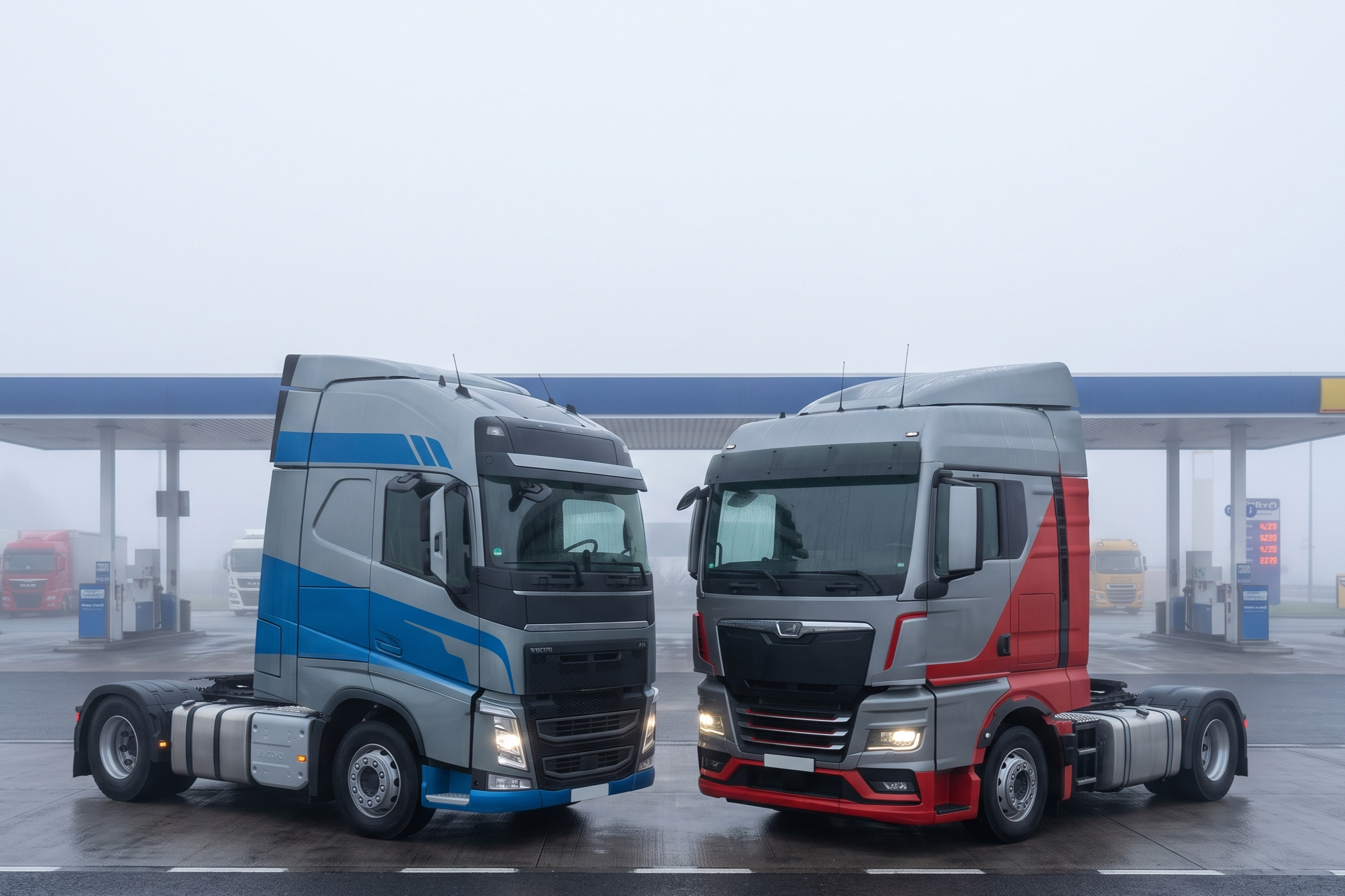
The Volvo FH and the MAN TGX are two of the most widely used heavy tractor units in European long-haul road transport, the flagship over-40-tonne class that pulls most international and long-distance semitrailer work. Both are current Euro 6 trucks built around a six-cylinder in-line diesel engine, an automated 12-speed gearbox and a tall long-distance sleeper cab, so this is a like-for-like comparison of two direct competitors rather than trucks from different weight classes.
This comparison is based on AssetBase data. On the Volvo side it covers the FH built on the 12.8-litre D13 engine platform, offered as diesel, as the fuel-saving D13 I-Save turbocompound version, as the G13 gas-powered variant and as the battery-electric Volvo FH Electric. On the MAN side it covers the TGX, which spans a wider engine platform: the 9.0-litre D1556, the 12.4-litre D2676, the 12.7-litre D3066 and the 15.2-litre D3876.
The two are close enough in role and market position that fleet buyers routinely cross-shop them, but they are not identical. The clearest differences show up in engine range and top output, cab structure and the way each brand packages alternative fuels, rather than in their core long-haul purpose, which is effectively the same.
Both trucks target the same job, a mainstream heavy tractor unit for long-distance haulage, so the useful comparison is about engine choice, cab format and fuel strategy, not category fit.
Volvo FH vs MAN TGX at a glance
At a glance, these two trucks are more alike than different. They share the same asset type, a similar Euro 6 emissions standard, an automated 12-speed transmission and a walk-through flat-floor sleeper cab built for nights away. The most important high-level difference is engine breadth. The Volvo FH is built around a single 12.8-litre D13 diesel platform rated from 420 to 540 hp, supported by gas and battery-electric versions of the same truck. The MAN TGX offers a broader spread of diesel engines, from the 9.0-litre D1556 at 330 hp up to the 15.2-litre D3876 at 640 hp. In practice this means the TGX reaches higher headline power inside its own range, while Volvo positions its highest outputs in the separate FH16, without either approach being better on its own.
The first thing to notice is that both trucks cover the mainstream 420 to 540 hp long-haul band almost identically, so the choice usually comes down to engine preference, cab layout, fuel strategy and dealer support rather than raw pulling power.
Models and variants compared
The two sides differ in how each range is structured. The Volvo FH is presented as one model family offered in several drivelines: the D13 diesel, the D13 I-Save turbocompound diesel tuned for lower fuel use, the G13 gas engine and the battery-electric Volvo FH Electric. Higher outputs above 540 hp are handled by the separate Volvo FH16, which is not the subject of this comparison. The MAN TGX is offered as one model family across four diesel engine platforms (D1556, D2676, D3066 and D3876) and a range of chassis layouts from 4x2 tractors to multi-axle rigids. MAN's electric long-hauler is the separate MAN eTGX rather than a variant of the diesel TGX.
This means the comparison is essentially one Volvo model family against one MAN model family, each configured through engine choice, chassis layout and cab type. Where a single figure is needed, the Volvo values below reflect the D13 diesel range and the MAN values reflect the full TGX diesel range.
The main model-scope difference is fuel strategy: Volvo keeps gas and electric inside the FH range, while MAN splits its electric long-hauler into the separate eTGX.
Key specification comparison
For heavy tractor units, the specifications that matter most for cross-shopping are engine displacement, power and torque, the emissions standard and the cab format, because these shape fuel use, gradeability, driver comfort and how the truck is spec'd for a given route. Both trucks use a proven six-cylinder in-line diesel with an automated overdrive gearbox, so the meaningful differences are in engine range and cab structure rather than basic layout.
On headline numbers the two overlap heavily in the mainstream band and separate at the top. The Volvo FH diesel runs from 420 to 540 hp on a single 12.8-litre block, with the I-Save version lifting torque to 2,800 Nm for fuel-focused long-haul work. The MAN TGX starts lower at 330 hp on the compact 9.0-litre D1556 and climbs to 640 hp and 3,000 Nm on the 15.2-litre D3876, giving it a broader spread from light long-haul to heavy-haulage duty.
The practical takeaway is that for typical 40-tonne long-haul work at 420 to 500 hp the two are closely matched, and the TGX only pulls clearly ahead on paper when a route needs the 640 hp top engine. A more detailed technical comparison is available in AssetBase.
Operating format and practical use differences
In day-to-day operation both trucks are built around the same driver-first, long-distance format: a tall walk-through sleeper cab, an automated gearbox that handles gear selection, and driveline options tuned for motorway fuel economy. For a driver spending nights in the cab, the choice often comes down to cab feel and storage rather than performance. The Volvo FH Globetrotter cabs run up to about 220 cm of interior height in the XL, with a wide lower bed and large under-bunk drawers. The MAN TGX GX cab is the wide extra-high long-haul option, with the GM and GN cabs stepping down in roof height for operators who prioritise payload or lower running height.
For fleet teams, the bigger operational difference is how each brand handles fuel strategy. Volvo concentrates its efficiency and alternative-fuel options inside the one FH range, so a fleet can order diesel, I-Save turbocompound diesel, gas or electric versions of essentially the same truck and cab. MAN keeps the TGX as its diesel long-hauler and runs battery-electric long-haul under the separate eTGX badge, which can simplify diesel spec'ing but means the electric option sits in a different model.
For buyers and maintenance teams, engine choice drives the rest of the specification. The Volvo FH single-platform D13 keeps parts and service consistent across the range, while the MAN TGX four-engine spread lets an operator match displacement to route weight, from the light 9.0-litre D1556 to the 15.2-litre D3876 for the heaviest work.
The clearest difference shows up at the extremes: heavy high-power haulage and alternative-fuel fleets, where the two brands package their ranges differently.
Energy use and lifecycle CO₂ context
Fuel and energy data matters here because a long-haul tractor covers very high annual mileage, so small differences in fuel consumption per kilometre scale into large differences in running cost and emissions over a working life. Both the Volvo FH and MAN TGX are primarily diesel trucks, and both brands market efficiency features (Volvo's I-Save turbocompound driveline, MAN's long-haul fuel and cruise systems) aimed at cutting litres per 100 km on motorway routes.
Operational energy and lifecycle CO₂ should be understood separately. Operational CO₂ comes from the fuel burned in use and scales with mileage and load, while lifecycle CO₂ also depends on how the truck is built, the engine or battery system, transport, maintenance and end-of-life treatment. This distinction matters most when comparing a diesel truck with a gas or electric version, where the balance between production and in-use emissions shifts. EmissionBase® helps separate operational energy from broader lifecycle CO₂ assumptions such as production, battery or engine system, transport, maintenance and end-of-life treatment.
Directly comparable official CO₂ values on the same measurement basis are not available for both trucks across their full ranges, so this comparison focuses on engine and driveline differences rather than a single emissions figure.
Which asset fits which workflow?
There is no overall winner between the Volvo FH and the MAN TGX, because the better fit depends on the operating requirement. For standard 40-tonne European long-haul at 420 to 500 hp, the two are closely matched on power, torque and cab comfort, and the decision usually turns on driver preference, total cost of ownership and the strength of the local dealer and service network.
The picture separates at the edges of the range. If a route needs the highest diesel output in a single truck, the MAN TGX carries a 640 hp option inside the TGX line, whereas Volvo places its highest powers in the separate FH16. If a fleet wants diesel, gas and battery-electric versions of the same base truck and cab, the Volvo FH keeps those options together in one range, while MAN splits electric long-haul into the eTGX.
The decision logic is simple: pick the FH for range consistency and integrated alternative fuels, and the TGX for engine breadth and the highest in-range diesel power.
How this comparison fits into wider heavy-truck coverage
The Volvo FH and MAN TGX sit at the top of each brand's on-road truck line-up, so the comparison naturally connects to their neighbours. On the Volvo side, adjacent families include the higher-powered Volvo FH16, the versatile Volvo FM and the construction-oriented Volvo FMX, plus the lighter Volvo FE for regional and distribution work. On the MAN side, the TGX sits above the MAN TGS for construction and heavy-duty distribution and the lighter MAN TGM and TGL for regional and urban delivery.
Across the wider heavy-truck segment, the FH and TGX also compete with the Mercedes-Benz Actros, Scania R-series and S-series, DAF XF and XG, and Iveco S-Way, all in the same premium long-haul tractor class. Seen this way, the FH-versus-TGX question is one head-to-head inside a closely matched field of European flagship long-haul trucks.
The comparison fits into a broad heavy-truck category where several flagship tractor units are cross-shopped on power, cab and total cost rather than on category differences.
.png)

.png)
.png)
.png)
.png)

.png)