
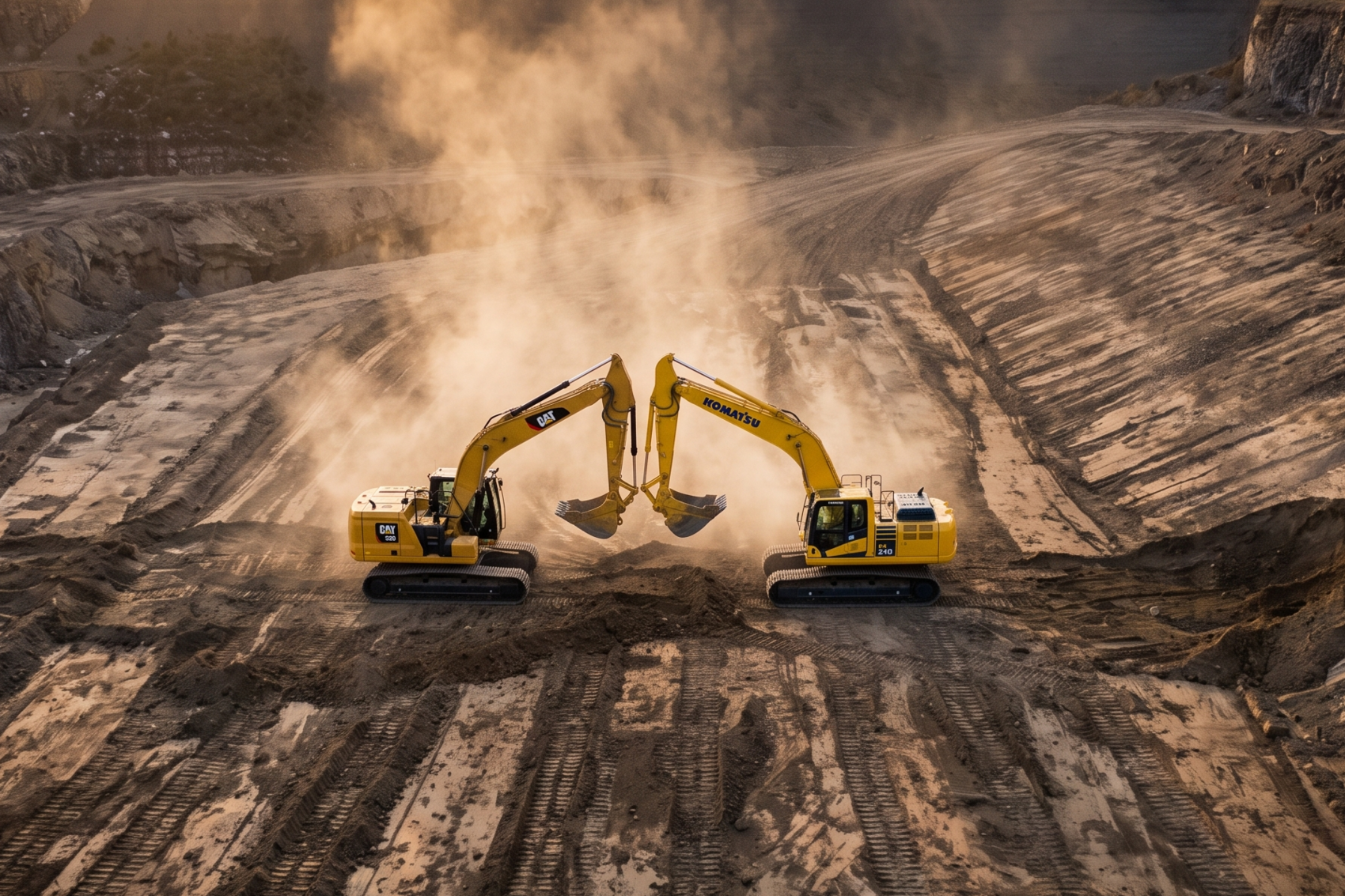
The Caterpillar 320 and the Komatsu PC210 are two of the most widely used crawler excavators in the 20 to 24 tonne class, the size that does most of the general earthmoving, trenching and site-preparation work on construction sites worldwide. Both are current, EU Stage V machines, so this is a like-for-like comparison of two direct competitors rather than machines from different size classes.
This comparison is based on AssetBase data. On the Caterpillar side it covers the current 320 built on the Cat C4.4 engine platform. On the Komatsu side it covers the PC210-11 family, which includes the standard PC210-11, the long-undercarriage PC210LC-11 and the narrow-undercarriage PC210NLC-11. Both machines sit close together on headline numbers: engine power of roughly 123 to 129 kW, operating weights in the 22,000 to 24,000 kg range, and maximum digging depth of about 6.6 to 6.7 m.
The two are close enough in size and role that buyers routinely cross-shop them, but they are not identical. The clearest differences show up in engine architecture, undercarriage choice and the way each brand packages technology and cab format rather than in raw digging numbers.
Both machines target the same job: a mainstream 20-tonne-class crawler excavator for general construction, so the useful comparison is about detail differences, not category fit.
Caterpillar 320 vs Komatsu PC210 at a glance
At a glance, these two machines are more alike than different. They share the same asset type, a similar operating weight, a similar power band and almost the same maximum digging depth. The most important high-level difference is in engine layout: the Caterpillar 320 uses a compact four-cylinder Cat C4.4, while the Komatsu PC210 uses a six-cylinder Komatsu SAA6D107E-3. That single design choice shapes a lot of the character of each machine, from how power is delivered to how the engine bay is serviced, without either approach being better on its own.
The first thing to notice is that the headline capability is very close, so the choice usually comes down to undercarriage options, engine preference and dealer support rather than digging performance.
Models and variants compared
The two sides differ in how the range is structured. The Caterpillar 320 is presented as one core model within Caterpillar's wider excavator line-up, configured with different boom, stick and bucket options. The Komatsu PC210 is offered as a small family that shares one platform but changes the undercarriage: the standard PC210-11, the long-track PC210LC-11 for extra stability and lift, and the narrow-track PC210NLC-11 for tighter or transport-sensitive sites.
This means the comparison is really one Caterpillar model against a three-variant Komatsu family. Where a single figure is needed, the Caterpillar values below use its published reference configuration and the Komatsu values reflect the range across its variants.
The main model-scope difference is that Komatsu lets you pick the undercarriage width up front, while the Caterpillar 320 is configured mainly through boom, stick and bucket choices.
Key specification comparison
On the specifications that matter most for a 20-tonne excavator, the 320 and PC210 track each other closely. Both deliver around 123 to 129 kW at the flywheel, both weigh roughly 22 to 24 tonnes in working trim, and both reach a maximum digging depth of about 6.6 to 6.7 m. For most general digging, loading and trenching, an operator would find the two very comparable in reach and depth.
The differences worth flagging are basis-related. Caterpillar publishes a heavy-duty reference bucket of 1.19 m³ with its stated operating weight, while Komatsu quotes a maximum bucket capacity of up to about 1.68 m³, so those two bucket figures are not measured on the same basis and should not be read as a direct gap. Engine power is also quoted slightly differently by each brand, though both fall in the same class.
The practical takeaway is that reach and depth are effectively a tie, so bucket sizing should be matched to material and duty rather than read straight from these figures. A more detailed technical comparison is available in AssetBase.
Operating format and practical use differences
In daily operation, both machines are conventional crawler excavators run by a single seated operator with joystick controls, so the core workflow of digging, slewing and loading feels familiar on either. The differences are in packaging. Caterpillar leans on its four-cylinder C4.4 with selectable power modes and a large touchscreen interface, aiming for simple, fuel-aware operation. Komatsu pairs its six-cylinder engine with multiple working modes, its SpaceCab operator station and the KomVision surround-view system.
For fleet teams, the biggest real-world variable is the undercarriage. Komatsu's LC and NLC options let you tune stability and transport width to the site before delivery, which matters for lift-heavy work or for jobs where transport dimensions are tight. The Caterpillar 320 is set up more around one standard undercarriage with configuration handled through work-equipment and bucket choice.
For buyers and maintenance teams, engine layout and dealer network usually weigh as heavily as spec sheets. A six-cylinder engine and a four-cylinder engine are serviced differently, and long-term running cost is shaped strongly by local parts availability, technician familiarity and support response, which vary by region.
The clearest difference appears when undercarriage matters: Komatsu's LC and NLC options give it more built-in flexibility for stability or transport, while general digging is effectively a tie.
Energy use and lifecycle CO₂ context
Both machines are diesel excavators certified to EU Stage V, so their operational emissions come from fuel burned per hour multiplied by how intensively they are used. A machine on continuous mass excavation will consume and emit far more over a year than the same model on intermittent utility work, which is why usage intensity often matters more than the small differences in rated power between these two.
Operational energy and lifecycle CO₂ should be understood separately. Fuel burn describes what the machine emits while working, but lifecycle CO₂ also depends on production, engine and aftertreatment systems, transport, maintenance and end-of-life treatment. Both brands use diesel particulate filtering and selective catalytic reduction with AdBlue to meet Stage V, so tailpipe treatment is broadly comparable, but published values here are not measured on a single shared test basis and should not be treated as a precise head-to-head. EmissionBase® helps separate operational energy from broader lifecycle CO₂ assumptions such as production, battery or engine system, transport, maintenance and end-of-life treatment.
For fleet teams comparing running cost, the most reliable approach is to model annual fuel use against real duty cycles rather than to compare single published figures.
Which asset fits which workflow?
Neither machine is an overall winner, because on the numbers that define a 20-tonne excavator they are close to level. The better fit depends on the operating requirement. If you need flexibility to set stability or transport width before the machine arrives, the Komatsu PC210 family gives you that through its LC and NLC variants. If you are standardising on one configuration and value Caterpillar's engine platform, interface and dealer footprint, the 320 is a natural fit.
In practice, most buyers decide on the basis of existing fleet standardisation, local dealer strength and operator preference. The specification gap is small enough that support and total cost of ownership usually carry more weight than any single figure.
The decision logic is simple: match the machine to your undercarriage needs and support network, because digging capability is effectively equal.
How this comparison fits into wider crawler excavator coverage
The 320 and PC210 sit in the middle of much larger crawler-excavator ranges. Caterpillar continues upward through models such as the 323 and 336, while Komatsu offers larger machines including the PC220 and PC290. Around this ~22-tonne class, other makes field directly comparable models, including the Volvo EC220, Hitachi ZX210, Doosan DX225 and JCB 220X, so cross-shopping is common at this size.
Placed in the wider taxonomy, this is a comparison within the crawler excavator subcategory of the construction industry, and it sits next to adjacent asset types such as wheeled excavators and larger mining-class excavators that share components but serve different duty profiles.
Seen in context, this pairing is one of several benchmark head-to-heads in the 20-tonne crawler excavator class, which is why it draws so much buyer research.
.png)
.png)
.png)
.png)
.png)
.png)