
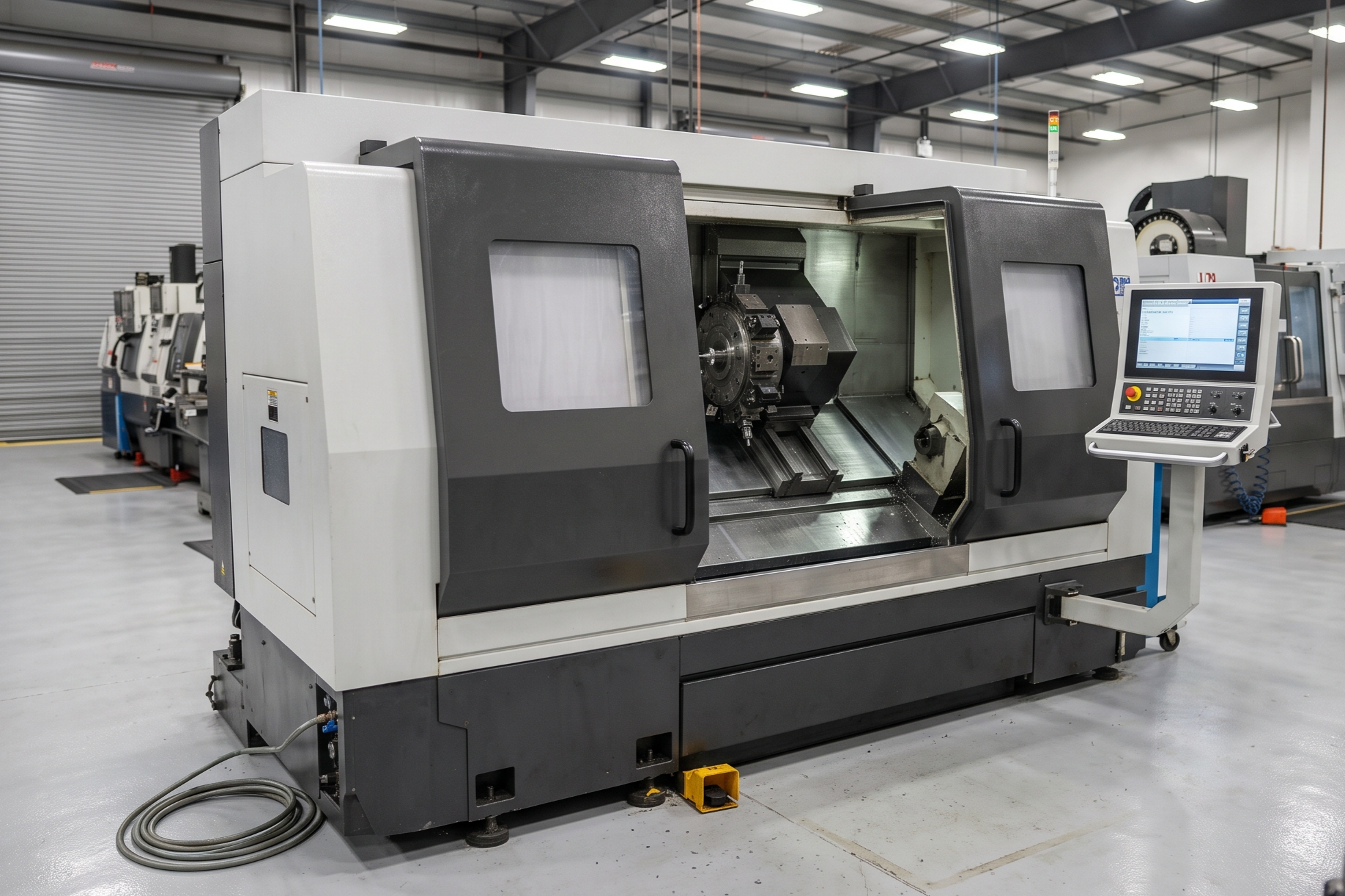
The Mazak QUICK TURN Series is the core line of CNC turning centers from Yamazaki Mazak, the Japanese machine tool builder. It is one of Mazak's best-selling families, built around a built-in motor spindle and a rigid machine frame, and it spans seven core sizes from the compact QT 100 to the big-bore QT 450. This profile is based on AssetBase data.
Across the family, the size number tracks capacity. The QT 100 runs a 6 inch chuck and spins to 6000 rpm for small precision and bar work, while the QT 400 and QT 450 take 12 to 21 inch chucks, turn up to Ø580 mm and swing up to Ø845 mm for large, heavy components. A single "QUICK TURN" badge therefore covers very different machines, so reading the size number, the chuck size and the variant suffix is the practical way to identify what a given machine actually is.
In the wider machine tool taxonomy, the QUICK TURN Series sits in the metalworking turning center segment, next to Mazak's twin-spindle HQR and MULTIPLEX lathes, the vertical MEGA TURN, and the multi-tasking INTEGREX machines. The values below are based on official OEM datasheets and sources.
The main takeaway: the QUICK TURN Series is one family but seven size classes, separated first by chuck and turning diameter and then by the variant suffix.
Mazak QUICK TURN Series models covered
The QUICK TURN Series is organised by a size number that rises with chuck size, turning diameter and spindle power. The smaller numbers are compact, high-rpm machines built for small parts and bar work; the middle numbers are general production turning centers; and the larger numbers are heavy machines for big and long components. The capacity figures below come from official OEM datasheets and sources.
The main takeaway: pick the size class by chuck and turning diameter first, then choose the exact size and variant within it.
What the Mazak QUICK TURN Series is used for
In practice, a QUICK TURN center makes round parts. The workpiece rotates in the chuck while a tool on the turret removes material to produce shafts, bushings, flanges, fittings and similar cylindrical components. Work is fed either as bar stock through the spindle bore or as individual blanks held in the chuck, which is why chuck size, turning diameter and bar capacity all matter when matching a machine to a job.
The compact QT 100 suits small, high-precision turned parts and bar work, where high spindle speed and a small footprint help. The mid-size QT 200 and QT 250 cover everyday production turning across a broad mix of materials, and the large-frame QT 300 and QT 350 handle bigger production parts and more complex multi-tasking work. The QT 400 and QT 450 are the heavy machines of the family, turning up to Ø580 mm with a Ø845 mm swing and bar capacity up to Ø165 mm for long shafts and large flanges.
Distance between centres sets how long a part the machine can turn, and the QUICK TURN Series covers a very wide span, from roughly 340 mm on a compact QT 100 up to more than 3,100 mm on a long-bed QT 400. The milling, second-spindle and Y-axis versions extend the family well beyond simple turning, so many QUICK TURN machines complete drilling, milling and back-end operations in the same setup.
Variants and configurations explained
Within each size, the suffix in a model name signals a real change in the machine rather than a trim level. The "M" suffix adds live (driven) tooling and C-axis positioning for milling; "MA" and "MB" are milling builds that differ mainly by turret type (bolt-on versus VDI). The "S" suffix adds an opposed second spindle for done-in-one machining of both ends, the "Y" suffix adds a Y-axis for off-centre features, and the centre-distance option (shown as a bed length such as 500U to 3000U) sets how long a workpiece the machine takes. For a buyer or production planner, these suffixes decide whether the machine can mill, whether it can transfer parts to a second spindle, and how long a part it can hold.
The main operational difference: the M, S and Y letters decide whether the machine can mill, run a second spindle or reach off-centre features, while the centre-distance number decides how long a part it can turn.
Key specification signals
For comparing machines across the QUICK TURN Series, the most useful signals are chuck size, maximum turning diameter and swing, spindle power and maximum spindle speed. Chuck and turning diameter set the part size, spindle power indicates how heavy a cut the machine can sustain, and spindle speed suits it to small or large diameters. As the size number rises, power and rigidity increase while top speed falls.
The numbers below are class-level figures based on official OEM datasheets and sources, using the representative spindle for each chuck size. Within a class the exact figure depends on the specific size, spindle option and configuration, so read them as comparison signals rather than single fixed values. Higher-torque and higher-output spindle options are offered on several sizes.
The practical takeaway: power and turning diameter climb with the size number while top speed drops, so compare machines within a chuck class rather than across the whole family. A more detailed technical profile is available in AssetBase.
Energy use and lifecycle CO₂ context
Energy data for turning centers is mostly electrical, and the clearest signal in the datasheets is installed spindle power, which ranges from 15 kW (20 HP) on the QT 100 to 37 kW (50 HP) on the largest machines. Servo axes, the hydraulic or built-in-motor chuck, the milling spindle on M variants, coolant pumps and chip conveyors add to the total. Actual consumption is not a fixed figure: it depends on how hard the machine cuts, the material, cycle time, idle periods and how much auxiliary equipment runs, so installed power should be read as a capacity signal rather than a running rate.
It is useful to keep operational energy separate from full lifecycle CO₂. A machine's running energy is only one part of its footprint. Production of the machine, transport, tooling and consumables, maintenance and end-of-life treatment all add separate assumptions, and the electricity mix used on site strongly affects the operational figure.
EmissionBase® helps separate operational energy from broader lifecycle CO₂ assumptions such as production, transport, maintenance and end-of-life treatment. This keeps the installed-power figures from the datasheets distinct from modelled lifecycle estimates.
How this asset fits into wider turning coverage
Within Mazak's own range, the QUICK TURN centers sit next to related turning families that handle jobs the standard QUICK TURN is not built for. The twin-spindle HQR and MULTIPLEX machines turn both ends at once for high-volume work, the vertical MEGA TURN takes large, heavy discs and rings on a vertical spindle, and the QT-COMPACT covers smaller-footprint production. The QUICK TURN Series is the general-purpose, horizontal single-spindle core of that line-up.
Across the market, the QUICK TURN Series competes with turning center ranges from other machine tool makers, and within the broader taxonomy it sits alongside adjacent asset types such as turning-milling centers and multi-spindle automatic lathes, as well as Mazak's own INTEGREX multi-tasking machines and machining centers. Comparisons are most meaningful within a matched chuck and spindle class rather than across the whole family at once.
The takeaway: the QUICK TURN Series is the single-spindle horizontal turning core of a wider machine tool line-up, best compared within a matched chuck and spindle class.
.png)

.png)

.png)
.png)
.png)
.png)