
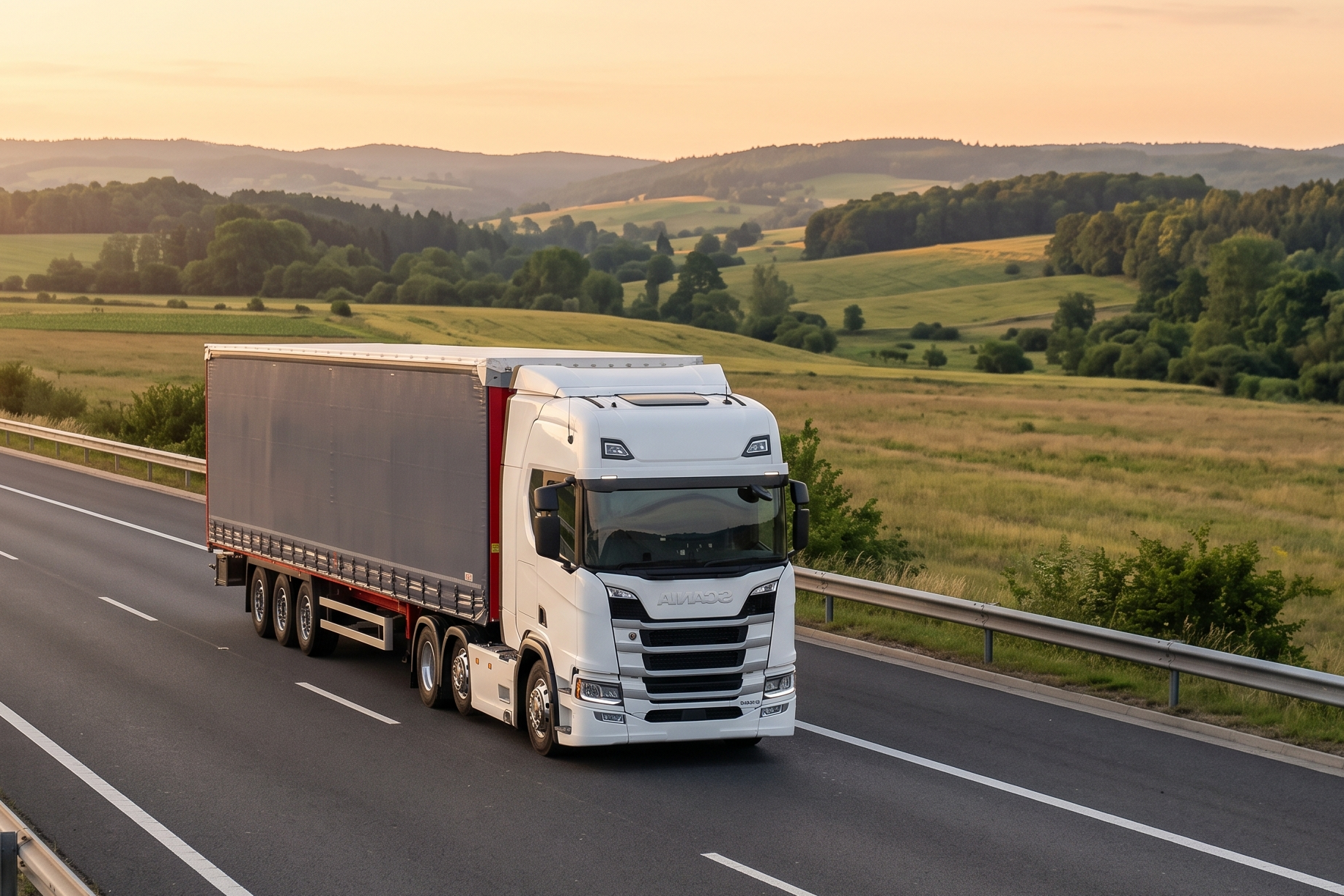
The Scania R-series is a heavy truck family built by Scania, part of the TRATON Group. First introduced in 2004 as the successor to the Scania 4-series, it is the brand's main long-distance and heavy-haulage range, built around the high R-cab and offered as both semitrailer tractors and rigid chassis. This evolution profile is based on AssetBase data.
This profile groups the R-series lineage into four major phases defined by emission standard: Euro 3, Euro 4, Euro 5 and Euro 6. These four phases also span two product generations, the original R-series from 2004 and the New Truck Generation R-series from 2016, with the Scania Super 13-litre powertrain arriving in 2021 inside the current Euro 6 phase. The current range is powered by 9-litre, 13-litre, Scania Super 13-litre and 16-litre V8 engines, with outputs reaching 770 hp.
The R-series is used for regional, national and international haulage, heavy transport and construction work. Generation identity matters because the same family name now covers everything from an early Euro 3 truck without SCR aftertreatment to a current Euro 6 Scania Super or a 770 hp V8. For valuation, fleet and ESG workflows, two records that both read "Scania R-series" can describe very different assets.
A long-running heavy truck family whose engines and emissions systems have moved a long way since 2004, organised in this profile across four major emission phases.
Scania R-series evolution at a glance
The R-series name covers two decades of one heavy truck family. Across that span the basic role, a high-cab tractor or rigid for long-distance and heavy transport, has stayed constant, while the engines, emissions systems, cab generation, electronics and fuel options have all changed. The same model name can therefore describe a 2004 Euro 3 truck, a Euro 5 workhorse from the early 2010s, a 2016 New Truck Generation cab or a current Euro 6 Scania Super.
Because the range is grouped by emission standard rather than by one clean row per generation, this profile uses four phases defined by Euro standard. In Scania's naming, the letter marks the cab (here the high R-cab) and the number that follows approximates engine output in horsepower, so an R 450 is an R-cab with a 450 hp engine and an R 770 uses the 770 hp V8.
The takeaway: one family, four emission phases and two product generations. The Euro 6 phase covers both the New Truck Generation cab from 2016 and the Scania Super powertrain from 2021.
Current or latest datasheet-covered line-up
The current R-series is a Euro 6 range built around four engine families that share the high R-cab. The 9-litre DC09 is a straight five-cylinder diesel with outputs from 280 hp to 360 hp and torque from 1,400 Nm to 1,700 Nm, suited to medium-duty urban and regional work up to about 40 tonnes. The 13-litre DC13 is a straight six-cylinder with outputs from 370 hp to 540 hp and torque up to 2,700 Nm, suited to heavy-duty regional, national and international operations.
Alongside the standard 13-litre, the range includes the Scania Super 13-litre, a fuel-efficiency engine that uses the Twin-SCR dual-AdBlue system and dual overhead camshafts. It is offered from 420 hp to 560 hp, with torque from 2,300 Nm to 2,800 Nm, and Scania links it to powertrain fuel savings of 8 percent. At the top of the range, the 16-litre DC16 V8 runs from 530 hp to 770 hp, with torque from 2,800 Nm to 3,700 Nm, for heavy-duty and super-heavy-duty work.
All of these engines can run on HVO without modification, several support biodiesel (FAME), and gas versions are available on the 9-litre and 13-litre for CNG and LNG. Body configurations cover both tractor and rigid, with a wide choice of axle layouts.
The main difference across the current range is engine family and duty class: the 9-litre for lighter regional work, the 13-litre and Scania Super for mainstream heavy haulage, and the 16-litre V8 for the heaviest loads.
Major turning points in the model lineage
A handful of changes shape how the R-series should be understood. The 2004 launch established the R-series and the high R-cab as the successor to the 4-series, and the range went on to win International Truck of the Year in 2005. Through the Euro 4 and Euro 5 phases the engines gained aftertreatment and higher outputs, with the 16-litre V8 rising to 620 hp.
The two most recent turning points sit inside the Euro 6 phase. In 2016 Scania introduced the New Truck Generation, a new cab and chassis platform with improved efficiency, safety and comfort that the R-series shares with the flagship S-series. In 2021 the Scania Super 13-litre powertrain arrived, using the Twin-SCR dual-AdBlue system to deliver around 8 percent powertrain fuel savings. These are not the same asset as an early R-series and should be identified separately.
Variants, body styles and special versions explained
The R-series name covers more than one technical truck. The cab letter, the power number, the engine family, the body configuration and the fuel type all point to real differences. The letter R marks the high forward control R-cab, offered in different roof heights, while the number that follows a Scania model name approximates engine output in horsepower. The engine family, whether 9-litre, 13-litre, Scania Super or 16-litre V8, sets the duty class, and the choice of tractor or rigid, plus the XT construction specification, changes how the truck is built and used. These labels belong here, not in the generation timeline.
Technical evolution and specification signals
The technical profile has moved a long way across the four phases. At Euro 3 the range topped out at 560 hp from the V8, with the 13-litre reaching 460 hp and the 9-litre from 250 hp, and the earliest trucks used engines without SCR aftertreatment. By Euro 4 and Euro 5 the V8 had risen to 620 hp and 3,000 Nm, the 13-litre range widened, and emissions control tightened with each standard.
The Euro 6 phase is the broadest and the most current. It adds the Scania Super 13-litre with the Twin-SCR dual-AdBlue system, extends the V8 to 770 hp and 3,700 Nm, and introduces gas versions of the 9-litre and 13-litre for CNG and LNG. Across the whole current range the engines can run on HVO without modification. Output, torque, emissions system and fuel type have all changed, so figures should be read alongside the phase they belong to. A more detailed technical profile is available in AssetBase.
The takeaway: peak power and torque climbed from 560 hp to 770 hp and from 2,700 Nm to 3,700 Nm, while the emissions system moved from early control to SCR and Twin-SCR, so output and fuel figures only make sense next to the emission phase.
Energy use and lifecycle CO₂ across generations
Energy and emissions behaviour differs across the R-series phases, driven first by emission standards and then by fuel and powertrain choice. The earliest Euro 3 trucks used engines without SCR aftertreatment, while later phases moved to SCR and, on the Scania Super, the Twin-SCR dual-AdBlue system. Because the range now covers diesel, HVO, biodiesel and gas, the fuel a given truck runs on changes its operational emissions as much as the engine does.
For practical analysis, operational energy and lifecycle CO₂ should be understood separately. A 770 hp V8 on diesel, a Scania Super on HVO and a gas-powered 13-litre have very different operating profiles, so a single "R-series" record is not enough to estimate emissions. EmissionBase® helps separate operational energy from broader lifecycle CO₂ assumptions such as production, engine system, transport, maintenance and end-of-life treatment.
Why generation identity matters
The "Scania R-series" name alone is not enough to identify the asset. A 2004 Euro 3 truck, a Euro 5 workhorse, a 2016 New Truck Generation R-series and a current Euro 6 Scania Super share a family name and a heavy-truck role, but they differ in emission standard, engine family, output, fuel capability, cab generation and electronics.
For asset finance, leasing, residual value, marketplace and ESG workflows this matters in practice. Two records that both read "R-series" can represent very different trucks with different valuations, maintenance profiles, emissions class and fuel needs. Resolving the asset needs the emission standard, the engine family and output, the product generation, the tractor or rigid configuration and the production year.
The emission phase and powertrain are the sharpest examples. An early Euro 3 R-series and a Euro 6 Scania Super are both "R-series", but they sit in different emission classes, run different aftertreatment and behave differently on residual value and total cost. Treating them as one asset type would distort any fleet, valuation or emissions view.
How this model family fits into wider heavy truck coverage
The R-series sits inside Scania's wider truck range. Adjacent same-make families include the flagship S-series with its flat-floor cab, the G-series and P-series for regional and distribution work, and the low-entry L-series for urban operations, along with the XT construction specification and Scania's battery-electric trucks. Within the R-series itself, the four engine families and the tractor and rigid formats cover a wide span of duty classes.
In the wider heavy truck segment the R-series competes with comparable long-distance tractors and rigids from other European manufacturers. From a taxonomy perspective the R-series is a heavy truck within the transportation industry, recorded as a semitrailer tractor or rigid chassis cab depending on the configuration, and by emission phase and fuel depending on the powertrain.
.png)
.png)
.png)
.png)
.png)
.png)