
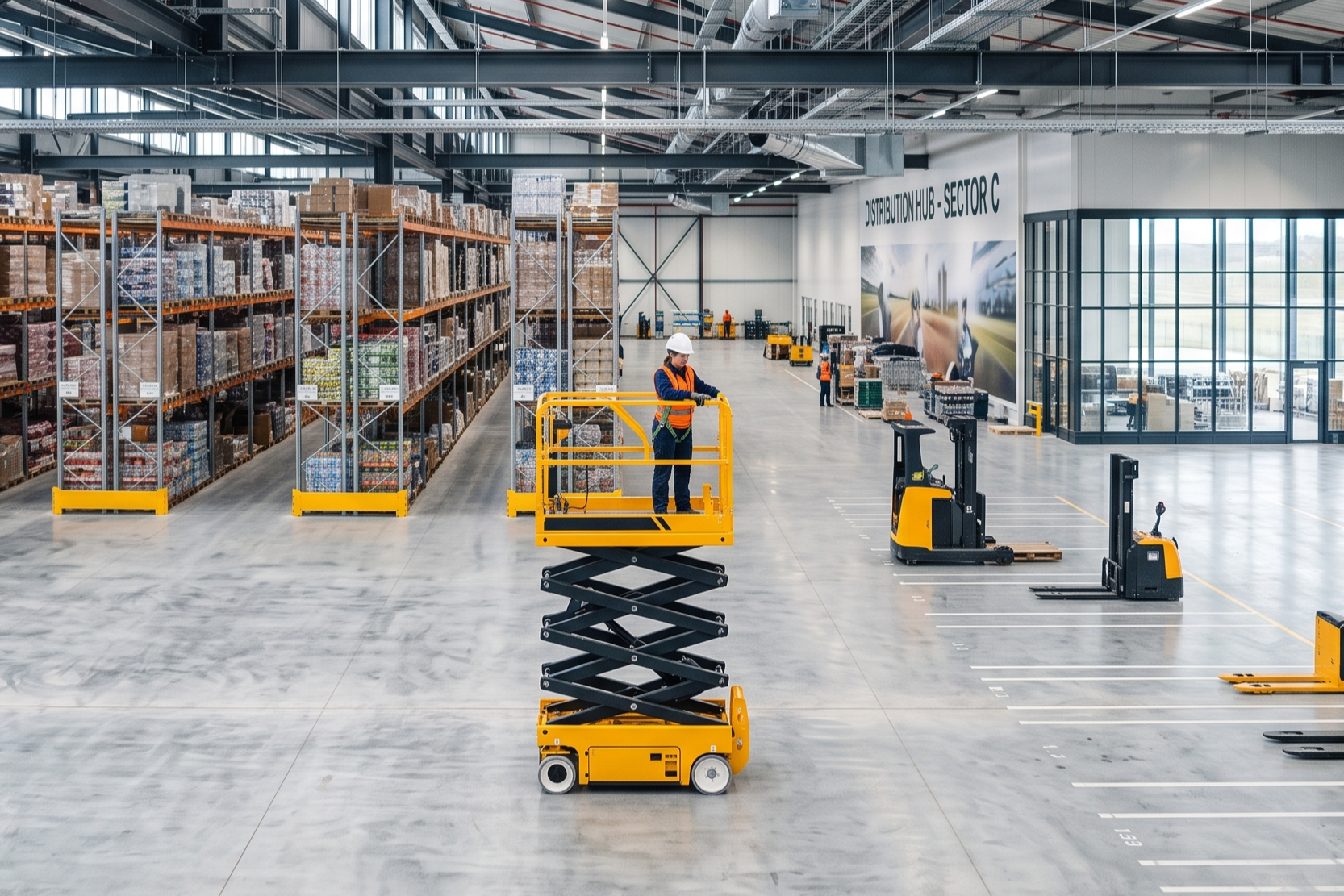
The Genie GS range is the scissor lift family from Genie, the aerial work platform brand of Terex Corporation (Terex AWP), based in Redmond, Washington. "GS" is Genie's designation for its scissor lifts, and the range divides into two broad families: compact electric "slab" scissor lifts built for firm, level surfaces, and rough terrain scissor lifts built for outdoor, uneven ground. This profile is based on AssetBase data.
Across the range, maximum working heights run from about 6.30 m on the smallest micro model (GS-1432m) to 18.15 m on the largest rough terrain machine (GS-5390), with platform lift capacities from 227 kg up to 1,134 kg. A useful shortcut sits inside the model number itself: the first two digits are the approximate platform height in feet and the last two are the machine width in inches, so a GS-3246 reaches about 32 ft on a 46 in wide chassis. The letters "m", "RT" and "DC" then describe the configuration.
In the wider construction taxonomy, the GS range sits within aerial working platforms, alongside boom lifts and vertical mast lifts. Reading the model group first, slab versus rough terrain, is the practical way to tell a quiet indoor electric scissor lift from a diesel or battery machine built for a jobsite.
The takeaway: GS is a whole scissor-lift catalogue rather than one machine, so the first read is always slab versus rough terrain, then the height and width class.
GS models covered
The GS range is best understood as five practical groups, split first by working environment (firm slab versus rough terrain) and then by size and deck width. The lightest are compact electric "micro" slabs at around 900 kg; the heaviest are diesel rough terrain machines with outriggers and optional dual decks.
The takeaway: place a machine in its group first, because a 900 kg micro slab and a 7,515 kg large rough terrain lift share little more than the family name.
What the GS range is used for
Slab scissor lifts are the core of the range and are built for firm, level surfaces. They run on solid non-marking tyres, are battery powered, and sound below 70 dBA, which suits them to indoor maintenance, installation, fit-out, warehousing and retail work as well as outdoor use on sound, flat ground. The compact models are deliberately narrow, from about 0.77 m to 0.82 m wide, so they pass through standard doorways and fit into goods lifts.
Deck width is the main lever on productivity. Narrow slab models carry 227 kg and suit one worker with tools, while the wider "46" and "55" deck models raise capacity to between 318 kg and 454 kg and add a slide-out extension deck, so two workers and materials can stay at height. Most slab models add a further 113 kg to 136 kg of capacity on the extension deck itself.
Rough terrain scissor lifts trade doorway access for ground capability. They use foam-filled tyres, more ground clearance (about 24 cm on the compact RT models), four-wheel drive and outrigger leveling, with gradeability from 35 percent up to 50 percent on the largest machines. That makes them the choice for construction sites, steelwork, cladding and outdoor maintenance where the ground is broken or sloped. Platform occupancy also climbs with size, from two people on the smallest slabs to as many as seven on the GS-3390 and GS-4390.
Variants and configurations explained
The most useful part of a GS name is the combination of number and suffix, because together they tell you how high the machine reaches, how wide it is, and where it is built to work. Two machines with similar heights can be a quiet indoor electric slab or a diesel jobsite lift depending only on those letters, so the suffix is what a buyer, fleet manager or operator should read first.
The main operational difference is environment: slab models (no terrain suffix) are battery-electric machines for firm, level floors, RT models are diesel machines for rough ground, and DC models are the battery-electric version of the same rough terrain chassis. Beyond these, slab models can be specified with flooded lead-acid, maintenance-free AGM or lithium-ion batteries, and the E-Drive option replaces hydraulic drive with sealed AC drive motors.
Key specification signals
For scissor lifts, a few numbers explain most of the practical difference between models. Working height sets how far up the platform reaches; platform lift capacity and deck width set how many people and how much material can go up; and power source, battery or diesel, sets which environment the machine belongs in. Occupancy and stowed width are secondary signals that decide access and crew size.
The figures below are grouped so the ranges stay readable. In practice, buyers fix the group and height first, then compare capacity and deck width within it. All values are based on official OEM datasheets and sources.
The takeaway: working height and capacity climb together up the range, so the quickest read on any GS lift is its group, then its height and capacity class within that group. A more detailed technical profile is available in AssetBase.
Energy use and lifecycle CO₂ context
Power source is the clearest dividing line in the GS range. Every slab model and the DC rough terrain models are battery-electric, drawing on a 24 V or 48 V DC system, and slab machines can be ordered with flooded lead-acid, maintenance-free AGM or lithium-ion batteries. The E-Drive option replaces hydraulic drive with sealed AC drive motors, which reduces energy losses and removes several hydraulic leak points. The RT and large rough terrain models are diesel, with fuel tanks of about 37.9 L on the compact RT machines and 75.7 L on the large ones.
How much energy any of these consume depends far more on how the machine is used than on its rating: the number of lift cycles, drive distance, load and idle time all change the energy used per shift. That is why the battery-electric DC models exist as a direct, zero-local-emission alternative to the diesel RT machines on sites where air quality or noise matters.
Comparing an electric and a diesel scissor lift on operational energy alone misses most of the picture, because production, the battery or engine system, transport, maintenance and end-of-life treatment all sit outside the fuel gauge or charger. EmissionBase® helps separate operational energy from broader lifecycle CO₂ assumptions such as production, battery or engine system, transport, maintenance and end-of-life treatment.
How this asset fits into wider aerial working platform coverage
Within Genie, the GS scissor lifts sit alongside the rest of the access line: Z-series articulating booms and S-series telescopic booms for reach over obstacles, GR "Runabout" vertical mast lifts for light single-person work, GTH telehandlers for material placement, and GL material lifts. The GS range is the scissor-lift core of that catalogue, covering both indoor slab work and outdoor rough terrain.
Against other makes, the GS scissors compete with comparable ranges from manufacturers such as JLG, Skyjack, Haulotte, Snorkel and Sinoboom, which offer their own slab and rough terrain scissor lifts. For classification and comparison, the useful anchors are the same across makes: platform working height, lift capacity, deck width and power source.
The takeaway: the GS range covers the vertical, straight-up part of working at height, with Genie's booms, mast lifts and telehandlers handling reach and material placement around it.
.png)
.png)
.png)
.png)
.png)
.png)