
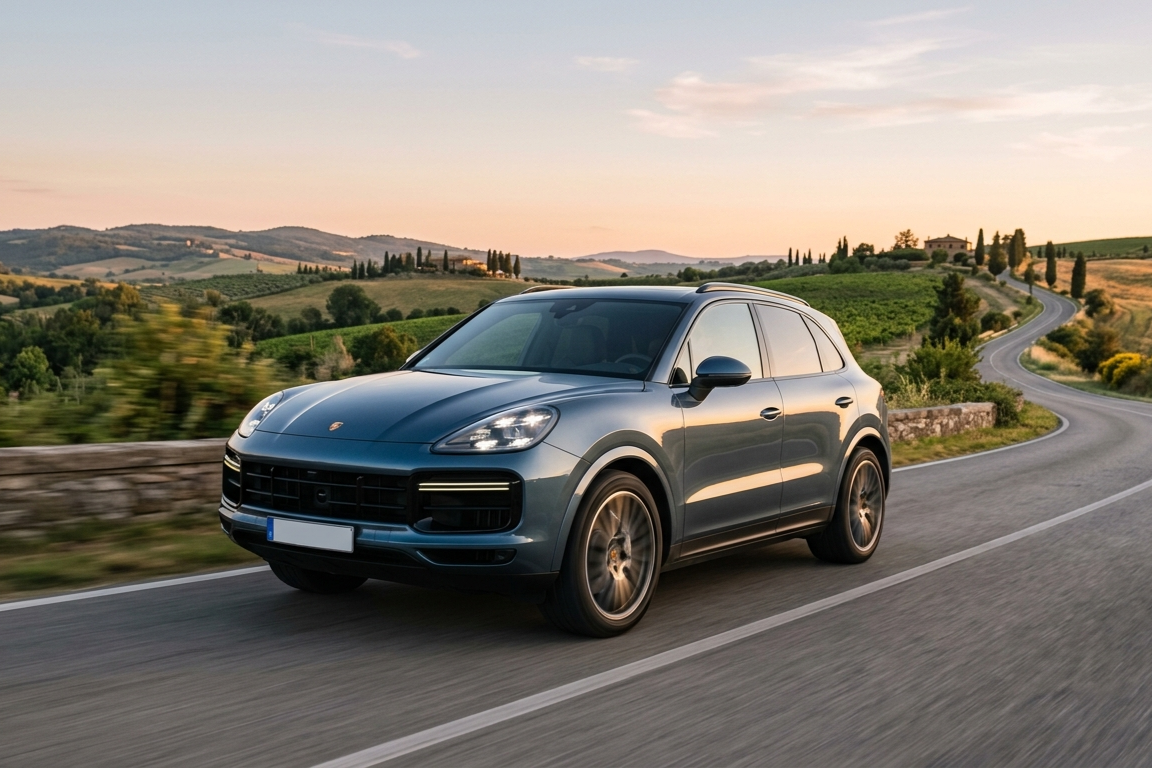
The Porsche Cayenne is a premium mid-large SUV from Porsche AG, part of the Volkswagen Group, first launched in 2003 as Porsche's first SUV and first four-door production model. Across three generations the Cayenne has covered ten main model designations and, since 2019, two body styles — the standard SUV and the Cayenne Coupé. This profile is based on AssetBase data.
The same Cayenne nameplate can mean very different hardware in practice. A first-generation base V6, a second-generation diesel and a third-generation Turbo S E-Hybrid share a name but differ in engine, drivetrain and operational behaviour. Reading both the generation year and the variant suffix is the practical way to identify what each unit on the market actually is.
In the wider passenger-car taxonomy the Cayenne sits in the premium mid-large SUV segment, overlapping with the smaller Porsche Macan and the higher-equipped Panamera derivatives, and competing with similarly positioned SUVs from other premium makes. Across more than two decades of production the family has covered petrol, diesel and plug-in hybrid powertrains under a single nameplate.
Porsche Cayenne models covered
The family groups around six functional categories: Base, S grade, GTS, Turbo, plug-in Hybrid and Track-focused. Diesel variants existed in the first two generations only and were replaced by plug-in hybrids in the current generation. The Cayenne Coupé is a body style available across most current variants rather than a separate model designation.
The six groups together cover all ten main Cayenne model designations across the family.
What the Porsche Cayenne is used for
In practice the Cayenne is a five-door, five-seat, all-wheel-drive SUV. It serves as family transport and long-distance touring, with rear-seat space and luggage volume suited to a premium passenger car. All current and recent Cayennes use an automatic transmission.
For operators the line between trims sits mostly in the powertrain. Base and S grades focus on daily and touring use, the GTS adds sport tuning, and the Turbo and Turbo S sit at the top of the combustion range. In the second generation the Cayenne Turbo S used a 4.8-litre twin-turbo V8 producing 570 hp, with a 0–60 mph time of 3.8 seconds and a 176 mph top track speed according to the 2015 datasheet.
Diesel variants were widely used in the first two generations for low fuel consumption and high torque, but are not part of the current generation. Plug-in hybrid variants now take on that long-range role, combining a V6 or V8 combustion engine with an electric motor to add electric-only driving for shorter trips.
For fleet teams and buyers, the most useful read is the combination of model year, variant suffix and body style. Two Cayennes of the same name from different generations can differ by more than 100 hp and by full powertrain type.
Variants and configurations explained
The main difference between Cayenne variants is the powertrain and the chassis hardware tuned around it. The same suffix can refer to different engines across generations, so the variant should always be read together with the model year.
The main operational difference between variants is powertrain type — petrol V6, petrol V8, diesel or plug-in hybrid — and the chassis and brake hardware tuned around it.
Key specification signals
For comparing units the most useful signals are powertrain type, peak power output and headline performance figures. According to the uploaded datasheets, output has ranged from 290 hp on the early base Cayenne to 670 hp combined on the Turbo S E-Hybrid, with the Turbo GT reaching 650 hp in the current generation.
For real-world comparison, transmission and drive layout, kerb weight and trailer ratings round out the picture. On plug-in hybrids the electric-only range and on-board AC charging power are the most useful additional comparators.
Output has roughly doubled across two decades, from 290 hp on the early base V6 to 670 hp combined on the Turbo S E-Hybrid.
A more detailed technical profile is available in AssetBase.
Energy use and lifecycle CO₂ context
Energy use across the Cayenne family is wide because three powertrain types share the same nameplate: petrol combustion, diesel combustion and plug-in hybrid. Real-world consumption depends heavily on use intensity — urban commuting, long-distance touring, towing and off-road use all change the picture.
For plug-in hybrid variants in particular, splitting operational energy into fuel and electricity matters. An E-Hybrid driven mostly on short urban trips with regular charging operates mostly as an electric vehicle; the same car on long highway journeys without charging operates mostly as a combustion vehicle.
Lifecycle CO₂ goes further than tailpipe or socket use. EmissionBase® helps separate operational energy from broader lifecycle CO₂ assumptions such as production, battery or engine system, transport, maintenance and end-of-life treatment.
How this asset fits into wider SUV coverage
Within Porsche, the Cayenne sits alongside the smaller Macan SUV and overlaps in equipment positioning with the higher-equipped Panamera derivatives. The Taycan, 911 and 718 sit in adjacent passenger-car segments. Outside Porsche, comparable premium mid-large SUVs come from a number of other premium and luxury makes that are commonly cross-shopped and traded against the Cayenne.
Within the wider passenger-car taxonomy, the Cayenne sits close to adjacent asset types — SUV hybrids and full electric SUVs — and to off-road derivatives. Reading the Cayenne against these adjacent types helps frame both market context and substitution decisions.
The Cayenne competes most directly with premium mid-large SUVs from German, British and Italian makes, while overlapping with adjacent Porsche families and SUV asset types.
.png)
.png)
.png)
.png)
.png)

.png)