
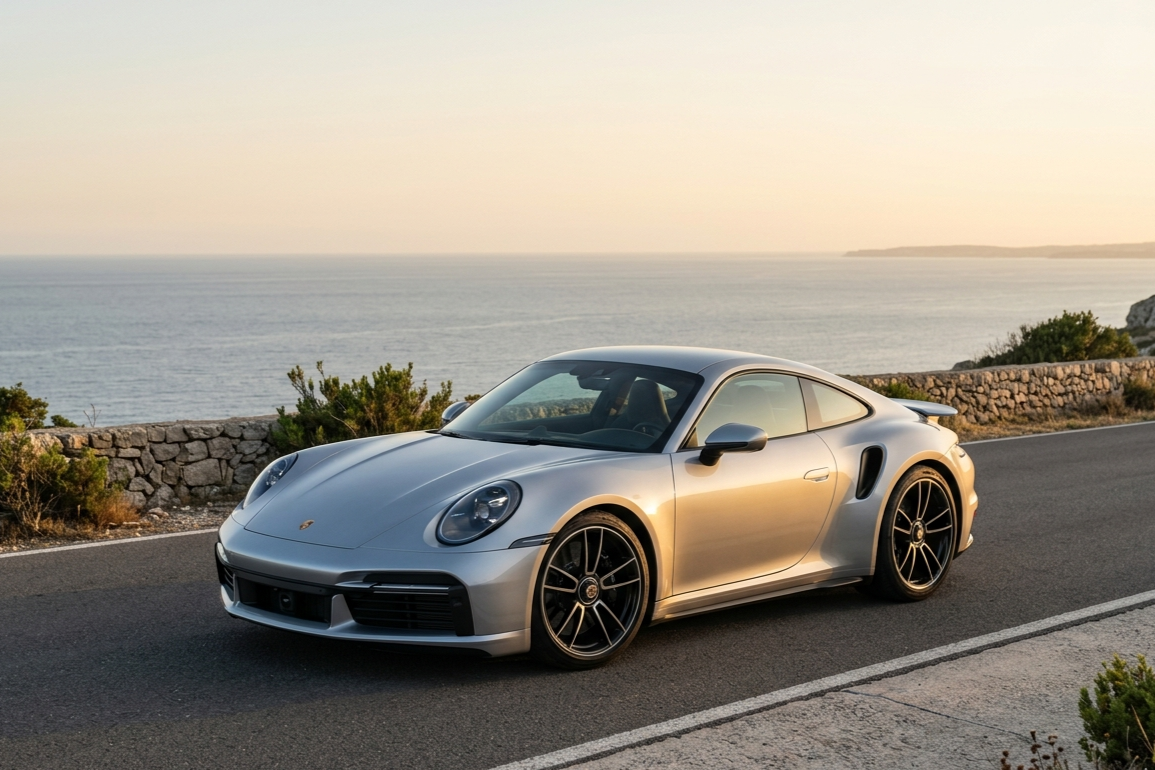
The Porsche 911 Turbo is the turbocharged variant of the Porsche 911, a rear-engined sports car family produced by Porsche AG. First introduced in 1974, it has remained part of the 911 line-up across eight generations and roughly five decades of development. This evolution profile is based on AssetBase data.
This profile covers all eight generations, organised here into six main phases that span more than four decades of development. The current line-up is built on the Type 992, the eighth generation, in production since 2020 and offered as the 911 Turbo and the 911 Turbo S in both Coupé and Cabriolet body styles. The 911 Turbo S, the top variant, develops 478 kW (650 PS) and 800 Nm, accelerates from 0 to 100 km/h in 2.7 seconds with Launch Control and reaches a top speed of 330 km/h.
The 911 Turbo is used as a road-going sports car and grand tourer. Generation identity matters because the same family name covers air-cooled and water-cooled engines, single-turbo and biturbo configurations, rear-wheel and all-wheel drive, and emissions profiles spanning more than four decades of regulation. For valuation, fleet and ESG workflows, two records that both read "Porsche 911 Turbo" can describe very different assets.
A long-running rear-engined sports car family in its eighth generation, organised in this profile across six main phases.
Porsche 911 Turbo evolution at a glance
The 911 Turbo name covers eight generations of one model family. Across those generations the basic format, a rear-mounted flat-six with forced induction, has remained, while displacement, cooling, induction layout, drive system, transmission and body styles have all changed. The same model name can therefore describe very different cars depending on the production year.
Current line-up and latest generation
The current 911 Turbo line-up is built on the Type 992 platform, in production since 2020. It is offered in two performance tiers, the 911 Turbo and the 911 Turbo S, each available as Coupé or Cabriolet. Both use a 3,745 cm³ flat-six with biturbo charging and variable turbine geometry (VTG), an 8-speed Porsche Doppelkupplungsgetriebe (PDK) and all-wheel drive.
The 911 Turbo develops 427 kW (580 PS) and 750 Nm, accelerates from 0 to 100 km/h in 2.8 seconds (Coupé, with Launch Control) and reaches 320 km/h. The 911 Turbo S develops 478 kW (650 PS) and 800 Nm, accelerates in 2.7 seconds (Coupé) and reaches 330 km/h. Combined CO₂ values sit at around 254 g/km for the Coupé and 257 g/km for the Cabriolet, with combined fuel consumption of 11.1 and 11.3 l/100 km respectively (Euro 6d-ISC-FCM).
In practice, the two tiers share engine architecture, transmission and drive layout. They differ in power output, torque, acceleration, top speed and equipment level.
The main difference between current variants is output and acceleration; architecture, transmission and drive layout are shared.
Major turning points in the model lineage
A handful of changes shape how the 911 Turbo should be understood. The 1974 launch established a rear-engined turbocharged 911 as a series production model. The shift from air-cooled to water-cooled engines around the turn of the millennium marked the clearest architectural break in the family.
Two later steps reshaped the powertrain again. Biturbo charging with variable turbine geometry standardised forced induction on two turbochargers. The move to an 8-speed PDK arrived with the current Type 992 platform. The Turbo S became a standard top variant during the 2013–2019 phase, broadening the range beyond a single Turbo trim. Limited editions joined the line-up too, including the 911 Turbo S Exclusive Series produced in 500 units with output raised to 446 kW (607 PS).
Variants, body styles and configurations explained
The 911 Turbo name covers more than one technical car. Suffixes and body labels point to real differences in engine output, transmission, body style and equipment level. "Turbo S" is not "Turbo", "Cabriolet" is not "Coupé", and an "Exclusive Series" is not a regular production variant. Each label signals a different specification and, in some cases, a different volume profile.
Technical evolution and specification signals
The technical profile has shifted substantially across the eight generations. The first phase used an air-cooled flat-six of around three litres with a single turbocharger. The early 1990s 3.6-litre phase kept air cooling at a larger displacement. The water-cooled phase from around 2000 changed the cooling system and emissions architecture. From the late 2000s, biturbo charging with variable turbine geometry became the standard induction layout.
The most recent two phases show the impact in numbers. The 3.8-litre phase from 2013 ran a 3,800 cm³ biturbo flat-six; by the 2015 and 2017 spec the Turbo developed 397 kW (540 PS) and the Turbo S 427 kW (580 PS), with combined CO₂ values around 212 g/km (Coupé). The current Type 992 uses a 3,745 cm³ biturbo engine, produces up to 478 kW (650 PS) in the Turbo S and shows combined CO₂ values of around 254 g/km for the Coupé under Euro 6d-ISC-FCM.
The technical profile has shifted substantially across the eight generations. The first phase used an air-cooled flat-six of around three litres with a single turbocharger. The early 1990s 3.6-litre phase kept air cooling at a larger displacement. The water-cooled phase from around 2000 changed the cooling system and emissions The takeaway: displacement, induction and emissions cycle have all moved, so CO₂ and performance figures should be read alongside the phase they belong to. A more detailed technical profile is available in AssetBase.
Energy use and lifecycle CO₂ across generations
Energy and CO₂ figures have changed substantially across phases, driven by powertrain architecture, vehicle weight, emissions regulation and test-cycle methodology. The shift from air-cooled to water-cooled engines, the move to biturbo VTG charging and the transition from older type-approval cycles to the current European cycle all affect how operational fuel consumption and CO₂ values look on paper.
For practical analysis, operational fuel use and CO₂ emissions should be understood separately from a fuller lifecycle CO₂ view. Operational figures are based on test-cycle fuel consumption and the petrol emissions factor. Lifecycle CO₂ adds assumptions for production, the engine system, transport, maintenance and end-of-life treatment. The uploaded datasheets do not print a directly comparable CO₂ value for every phase, so cross-phase comparisons must be read with the test cycle in mind.
EmissionBase® helps separate operational energy from broader lifecycle CO₂ assumptions such as production, engine system, transport, maintenance and end-of-life treatment.
Why generation identity matters
The "Porsche 911 Turbo" name alone is not enough to identify the asset. A 1975 first-phase Turbo Carrera, an early-1990s air-cooled 3.6, a water-cooled 911 Turbo from around 2000, a VTG biturbo Turbo from 2008, a 3.8-litre Turbo S from the 2013–2019 phase and a current Type 992 share a model family name and basic format. They differ in displacement, induction, power, drive layout, transmission, body style, weight, emissions profile and production era.
For asset finance, leasing, residual value, marketplace and ESG workflows this matters in practice. Two records that both read "Porsche 911 Turbo" can represent very different cars with different valuations, maintenance profiles, parts availability, operating costs and lifecycle CO₂. Generation or type code, body style, performance variant and production year are required to resolve the asset.
Limited editions add a further dimension. The 911 Turbo S Exclusive Series in 500 units is not the same asset as a standard Turbo S of the same year. Production volume and equipment differences carry through to residual value behaviour and lifecycle profile.
How this model family fits into wider sports car coverage
The 911 Turbo sits inside Porsche's wider sports car line-up, alongside other 911 derivatives and other Porsche model families. Adjacent same-make families include the 718 Boxster and 718 Cayman, the Panamera, and Porsche SUVs such as the Macan and Cayenne. Within the 911 family the Turbo line sits between the Carrera variants and motorsport derivatives such as the GT3.
In the wider high-performance sports car segment the 911 Turbo competes with comparable two-door performance vehicles from other premium manufacturers. From a taxonomy perspective the 911 Turbo is a passenger car within the transportation industry, recorded as a sports coupé or cabriolet depending on the variant.
.png)
.png)
.png)
.png)
.png)
.png)