
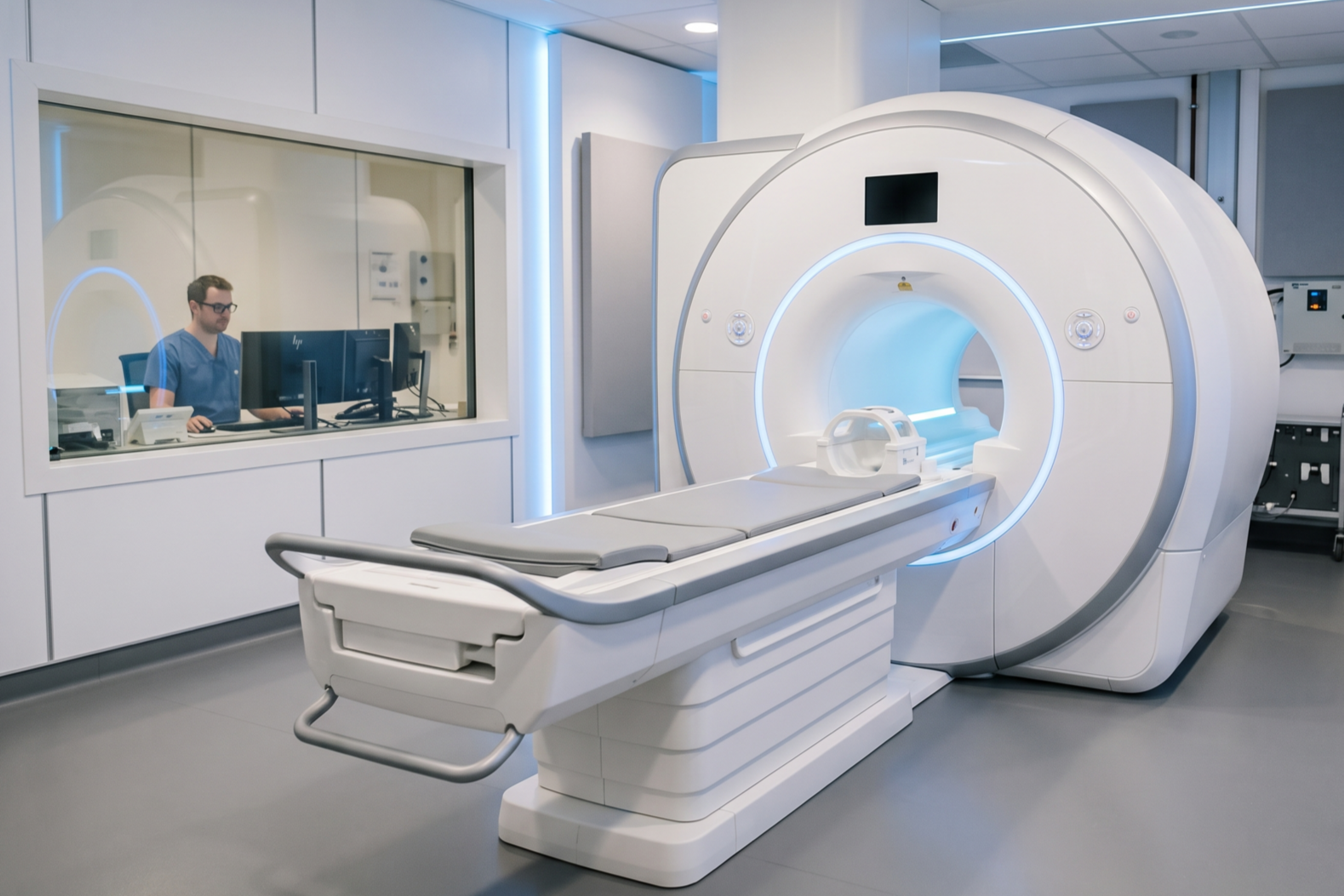
The Philips Ingenia is a family of magnetic resonance imaging (MRI) systems from Philips, the Dutch medical technology manufacturer. It is Philips' digital MRI platform, where the received signal is digitised in the coil rather than further down the chain, an approach Philips markets as dStream digital broadband. The profile covers five model lines: the core Ingenia (including Ingenia S and Ingenia Evolution), the high-gradient Ingenia CX, and the premium Ingenia Elition (Elition S and Elition X). This profile is based on AssetBase data.
All of these systems share a wide 70 cm patient bore and are offered at two main field strengths, 1.5 tesla (1.5T) and 3.0 tesla (3.0T). Field strength sets the basic signal-to-noise ceiling, while the gradient grade sets how fast and how strongly the scanner can encode an image. A single "Ingenia" badge therefore covers everything from a general-purpose 1.5T radiology system to a top-tier 3.0T platform with the strongest gradients in the range. Reading the model line and the field strength is the practical way to identify what a given system actually is.
In the wider medical imaging taxonomy, the Ingenia platform sits in the MRI segment, alongside Philips' CT and other diagnostic imaging lines, and competes with 1.5T and 3.0T systems from other major imaging makes. Across the family, the gradient amplitude ranges from roughly 33 mT/m on entry systems to 80 mT/m in dual-mode high-gradient configurations, and the maximum slew rate reaches 220 mT/m/ms on the Elition.
The main takeaway: Ingenia is one digital platform spanning several tiers, separated first by field strength and then by gradient grade.
Philips Ingenia models covered
The Ingenia platform is organised into model lines aimed at different combinations of field strength, gradient performance and budget. The core Ingenia, with its Ingenia S and Ingenia Evolution configurations, is the general-purpose line offered in 1.5T and 3.0T. The Ingenia CX adds higher-performance gradients for more demanding clinical work in both field strengths. The Ingenia Elition is the premium 3.0T line, available as Elition S and the higher-gradient Elition X. The values below come from the official OEM's datasheets.
The main takeaway: choose the line by field strength and gradient grade first, then select the configuration tier within it.
What the Philips Ingenia is used for
In practice, the Ingenia systems do the everyday work of a clinical MRI scanner: producing high-contrast images of soft tissue, the brain, spine, joints, abdomen, heart and vascular system, without ionising radiation. The patient lies on a motorised table that moves into the 70 cm bore, and surface coils placed on the body receive the signal that the dStream architecture digitises in the coil. The wide bore and feet-first or head-first positioning support a broad range of patients and exam types.
The core Ingenia line, in 1.5T and 3.0T, is built for general radiology departments handling routine neurological, musculoskeletal and body imaging across a mixed daily caseload. Its Ingenia S and Ingenia Evolution configurations let a site match the system to its budget and upgrade path while keeping the same digital platform.
The Ingenia CX and the 3.0T Elition target higher throughput and more demanding studies. Stronger gradients, reaching 80 mT/m in CX dual mode and slew rates up to 220 mT/m/ms on the Elition, support advanced techniques such as diffusion imaging and fast, high-resolution protocols. Philips states the Elition can perform exams substantially faster than earlier systems, which matters most for busy 3.0T services.
Variants and configurations explained
Across the Ingenia family, the name after "Ingenia" signals a real difference in performance tier rather than cosmetic trim. The S and Evolution labels mark configuration and upgrade tiers within the core line; CX marks a high-performance gradient build; and Elition marks the premium 3.0T line, where the X configuration carries the strongest Vega HP gradient. For a buyer, imaging manager or service team, these labels decide the gradient grade, the achievable scan speed and the upgrade path of a given system.
The main operational difference: field strength and gradient grade rise from the core Ingenia through CX to the premium Elition, which sets scan speed and the range of advanced techniques.
Key specification signals
For comparing systems across the Ingenia family, the most useful signals are field strength, patient bore, gradient amplitude and maximum slew rate. Field strength sets the baseline signal available, bore sets patient access, and the gradient figures determine how fast and how finely the scanner can encode images. Higher amplitude and slew rate support thinner slices, faster sequences and more demanding techniques.
The numbers below are taken directly from the uploaded datasheets and are grouped by line and field strength. Several lines offer more than one gradient build, so the ranges should be read as comparison signals rather than single fixed values.
The practical takeaway: the systems share the same 70 cm bore, so they are best compared on field strength and gradient performance, where the CX and Elition pull clearly ahead. A more detailed technical profile is available in AssetBase.
Energy use and lifecycle CO₂ context
Energy data matters here because MRI systems are among the most power-intensive devices in a hospital. They draw continuous power for the gradient and radio-frequency chain, the computing system and, above all, the cryogenic cooling that keeps the superconducting magnet at operating temperature, including standby hours when no patient is being scanned. The uploaded datasheets used for this profile focus on magnet and gradient performance and do not print a single comparable operational energy value per scan or per hour for every model, so energy should be treated as use-intensity dependent rather than a fixed figure.
It is useful to keep operational energy separate from full lifecycle CO₂. A scanner's running energy is only one part of its footprint; manufacturing, the magnet and helium system, installation and transport, maintenance, and end-of-life treatment all add separate assumptions. Two systems with similar in-use power can diverge once those wider stages, and the local electricity mix, are included.
EmissionBase® helps separate operational energy from broader lifecycle CO₂ assumptions such as production, the magnet or cooling system, transport, maintenance and end-of-life treatment. This keeps measured performance data distinct from modelled lifecycle estimates.
How this asset fits into wider MRI & CT coverage
Within Philips' own imaging range, the Ingenia platform sits next to the company's other MR families and its CT systems, with newer helium-light and helium-free MR platforms positioned alongside it in the wider portfolio. The Ingenia line is the established digital broadband part of that line-up, spanning entry 1.5T through premium 3.0T.
Across the market, the Ingenia systems compete with 1.5T and 3.0T scanners from other major imaging makes, and within the broader taxonomy they sit alongside adjacent imaging asset types such as CT, ultrasound, X-ray and mammography. Comparisons are most meaningful within a matched field strength and gradient class rather than across the whole family at once.
The takeaway: the Ingenia platform is the digital MRI core of a wider imaging line-up, best compared within a matched field strength and gradient class.
.png)

.png)


.png)
.png)
.png)

.png)