
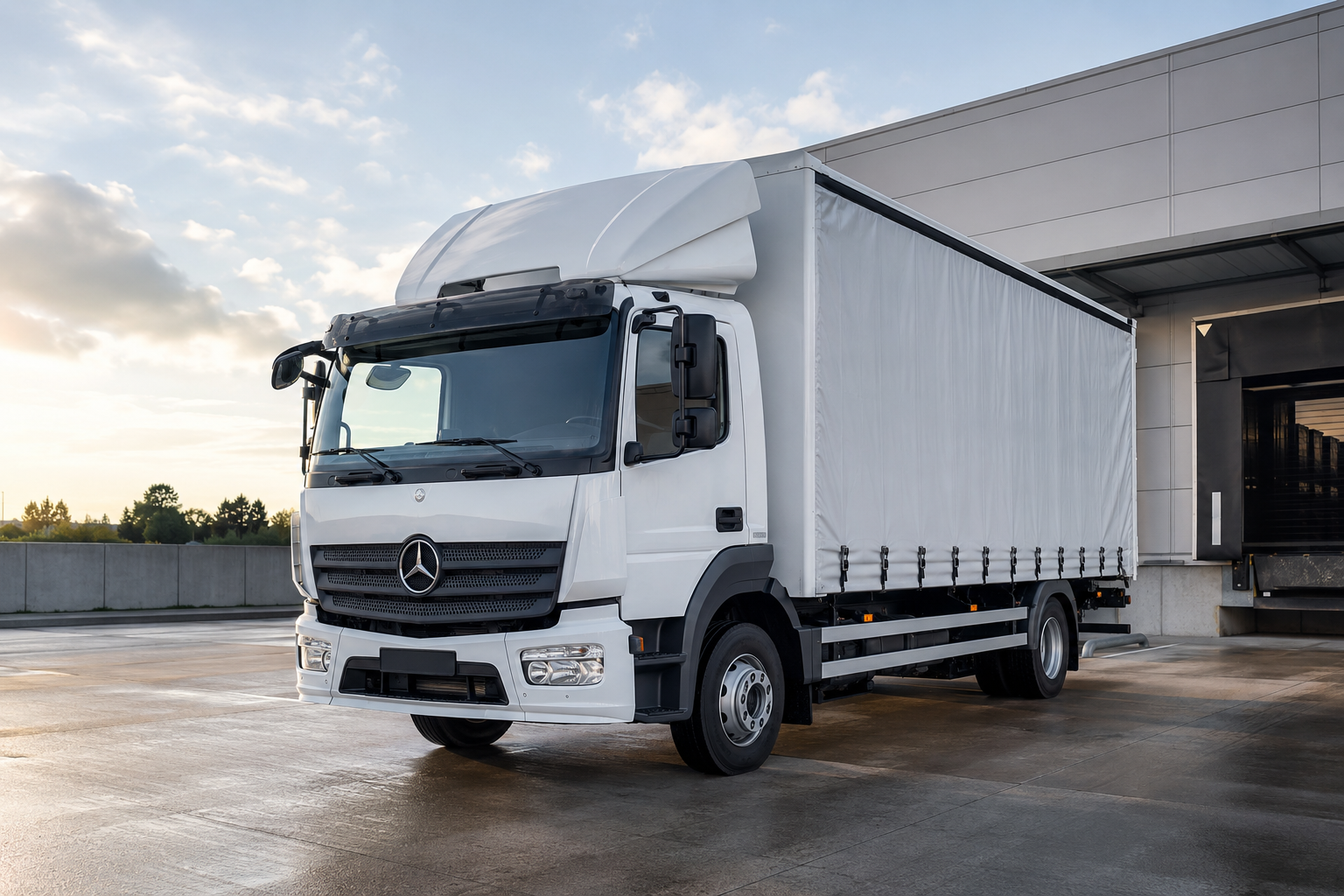
The Mercedes-Benz Atego is a distribution truck family built by Mercedes-Benz Trucks, part of Daimler Truck. First introduced in 1998 as the successor to the LK range, it is the brand's core medium-duty range for distribution haulage, covering rigid chassis, tippers and light tractors from roughly 6.5 tonnes up to 16 tonnes gross vehicle weight, with gross combination weights up to 34 tonnes on the strongest models. This evolution profile is based on AssetBase data.
This profile covers the Atego across three generations: the first generation from 1998, the redesigned second generation from 2004, and the current third generation from 2013. The current line-up is the Euro VI third generation, sold across model designations from the 716 up to the 1530, in rigid, tipper and tractor forms. The four-cylinder models use the OM 934 in-line engine and the six-cylinder models use the OM 936, paired with manual or PowerShift Advanced automated transmissions and a choice of four cab variants.
The Atego is used for urban and regional distribution, municipal work, construction site supply and light haulage. Generation identity matters because the same family name now covers three distinct cab and driveline eras and a wide span of weight and power classes. For valuation, fleet and ESG workflows, two records that both read "Mercedes-Benz Atego" can describe very different assets.
A long-running medium-duty distribution family across three generations, with the current third generation running a Euro VI diesel range.
Mercedes-Benz Atego evolution at a glance
The Atego name covers more than 25 years of one distribution truck family. Across that span the basic role, a medium-duty rigid, tipper or light tractor for distribution and regional work, has stayed constant, while the cab, engines, electronics and emission standards have all changed. The same model name can therefore describe a 1998 first-generation truck, a redesigned second-generation Atego or a current Euro VI third-generation model.
Because each generation introduced a different cab and driveline, this profile treats the lineage as three generations, with the current third generation described directly by the uploaded datasheets and the earlier two used for lineage context.
The takeaway: one family, three generations. Only the third generation is described directly by the uploaded datasheets; the earlier generation names are used for lineage context.
Current or latest datasheet-covered line-up
The current Atego is the third generation, introduced in 2013 and described across the uploaded Euro VI datasheets. It is offered as a rigid chassis, a tipper chassis and a light tractor unit, with two- and three-letter suffixes marking the body and cab format and 4x2 or 4x4 drive. Gross vehicle weights run from 6.5 tonnes on the 716 up to 15 tonnes on the 15-series, with gross combination weights reaching 34 tonnes on the strongest models.
The range uses two engine families. The lighter models run a four-cylinder in-line diesel, the OM 934, with outputs printed in the datasheets at 115 kW (156 hp), 130 kW (177 hp), 155 kW (211 hp) and 170 kW (231 hp). The heavier models run a six-cylinder in-line diesel, the OM 936, at 175 kW (238 hp), 200 kW (272 hp) and 220 kW (299 hp). Torque spans 650 Nm to 1,200 Nm, and every model in the datasheets is Euro VI.
Buyers choose between four cab variants in the datasheets, the S cab ClassicSpace, the extended S cab ClassicSpace, the L cab ClassicSpace and the L cab BigSpace, plus manual or PowerShift Advanced automated transmissions. In practice, the model number encodes the weight class and the power class, so the line-up scales from a compact 7.5-tonne urban delivery truck up to a 15-tonne, 299 hp regional workhorse.
The main difference across the current range is engine class and weight rating: the four-cylinder OM 934 covers the lighter, lower-output models and the six-cylinder OM 936 covers the heavier, higher-torque models.
Major turning points in the model lineage
A handful of changes shape how the Atego should be understood. The 1998 launch established the Atego as a clean-sheet distribution range to replace the LK, offered at launch in around 25 basic types and 240 model variants, and it was named International Truck of the Year in 1999. The 2004 second generation brought a redesigned front end and a cockpit grouped more closely around the driver, with a further facelift in 2010.
The most important change for current records is the 2013 third generation. It introduced the Euro VI OM 934 four-cylinder and OM 936 six-cylinder engines that define every model in the uploaded datasheets, alongside the PowerShift Advanced automated transmission. These engine and transmission identifiers are the clearest way to separate a current Atego from the two earlier generations.
Variants, body styles and special versions explained
The Atego name covers more than one technical truck. The model number, body suffix, drive code and cab name all point to real differences. The four-digit model number encodes a weight class and a power class: in "Atego 1530", the first two digits indicate the gross weight class and the last two a power code, so 1530 is a 15-tonne-class truck with 220 kW (299 hp). Suffixes mark the body and cab format, and 4x2 or 4x4 marks the drive. These labels belong here, not in the generation timeline.
Technical evolution and specification signals
The technical profile has shifted across the three generations. The first and second generations established and then refined the medium-duty diesel distribution format, with the 2004 generation focused on a redesigned cab and cockpit. The uploaded datasheets do not print directly comparable power or torque values for those earlier generations, so cross-generation engine comparison is not possible from this data alone.
The current third generation is fully described by the datasheets. It runs the Euro VI OM 934 four-cylinder engine at 115 kW (156 hp) to 170 kW (231 hp) and the OM 936 six-cylinder at 175 kW (238 hp) to 220 kW (299 hp), with torque from 650 Nm to 1,200 Nm. Drive is 4x2 or 4x4, transmissions are manual or PowerShift Advanced, and four cab variants are offered. The clearest technical signal of a current Atego is the OM 934 or OM 936 Euro VI engine.
The takeaway: the current generation is the only one with datasheet-printed power and torque figures, so output values should be read as third-generation, Euro VI data. A more detailed technical profile is available in AssetBase.
Energy use and lifecycle CO₂ across generations
Energy and emissions behaviour on the Atego is driven by emission standards and by how intensively each truck is used. The current third-generation models in the uploaded datasheets are Euro VI diesels, but the datasheets do not print a directly comparable CO₂ figure per model, so cross-model or cross-generation emissions cannot be compared from this data alone. A distribution truck's real emissions depend heavily on duty cycle, payload, route and annual distance.
For practical analysis, operational energy and lifecycle CO₂ should be understood separately. A diesel Atego consumes fuel per kilometre, and that operational figure is only part of the picture: production, the engine and exhaust system, transport, maintenance and end-of-life treatment all add to the lifecycle total. Because usage intensity varies so widely across distribution roles, a single "Atego" record is not enough to estimate emissions on its own.
EmissionBase® helps separate operational energy from broader lifecycle CO₂ assumptions such as production, battery or engine system, transport, maintenance and end-of-life treatment.
Why generation identity matters
The "Mercedes-Benz Atego" name alone is not enough to identify the asset. A 1998 first-generation truck, a redesigned second-generation Atego and a current Euro VI third-generation model share a family name and a distribution role, but they differ in cab generation, engine family, power, emission standard and electronics.
For asset finance, leasing, residual value, marketplace and ESG workflows this matters in practice. Two records that both read "Atego" can represent very different trucks with different valuations, maintenance profiles, parts availability and lifecycle CO₂. Resolving the asset needs the generation, the model code, the body suffix, the drive configuration, the cab variant and the production year.
The model number is a good example. An Atego 816 and an Atego 1530 are both current Euro VI trucks, but one is a light 7.5-tonne-class delivery truck with a 115 kW (156 hp) four-cylinder engine and the other is a 15-tonne-class truck with a 220 kW (299 hp) six-cylinder engine. Treating them as one asset type would distort any fleet, valuation or emissions view.
How this model family fits into wider rigid chassis cab coverage
The Atego sits inside Mercedes-Benz Trucks' wider truck line-up as the medium-duty distribution range. Adjacent same-make families include the Antos for heavy distribution, the Actros and Arocs for long-distance and construction haulage, the Econic for municipal and urban work, and the Unimog and Zetros for off-road duty, alongside the electric eActros and eEconic. The Atego itself covers rigid, tipper and light tractor roles within the distribution segment.
In the wider medium-duty segment the Atego competes with comparable distribution trucks from other European manufacturers. From a taxonomy perspective the Atego is a truck within the transportation industry, recorded as a rigid chassis cab, tipper or light tractor depending on the configuration, and as a Euro VI diesel on the current generation.
.png)

.png)
.png)
.png)
.png)
.png)