
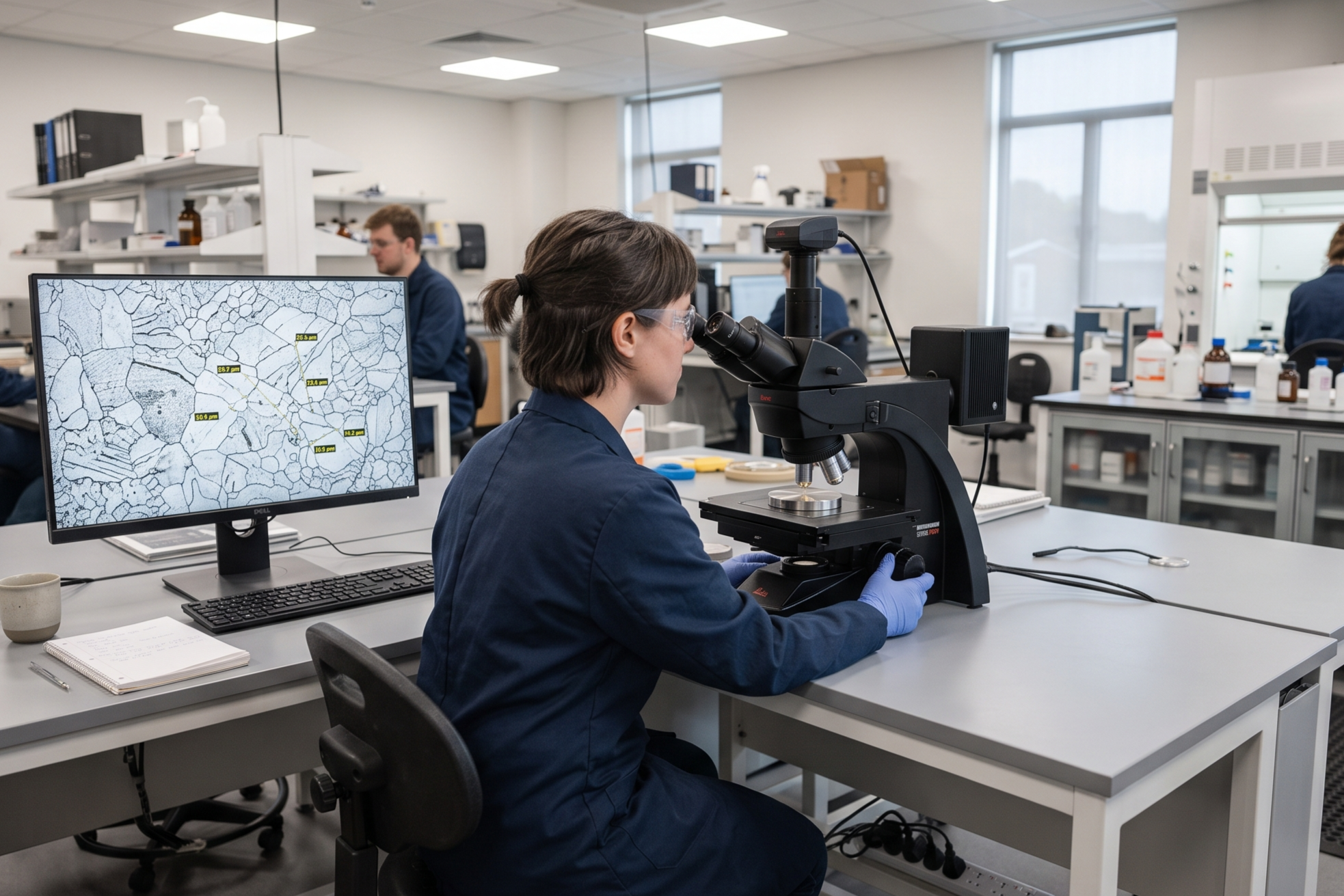
PRECiV is Evident's industrial microscopy software family, built specifically for materials science and industrial inspection rather than life-science imaging. It runs a single, unified interface across Evident's conventional optical and stereo microscopes and the DSX series digital microscopes, covering the full workflow from image capture to standard-compliant measurement, reporting and data sharing. This profile is based on AssetBase data.
The family is offered as five editions: PRECiV Capture, PRECiV Core and PRECiV Pro for conventional microscopes, PRECiV DSX for digital microscopes, and PRECiV Desktop for offline processing on networked PCs. A separate layer of optional Materials Solutions add-ons (such as Count and Measure, Grain Sizing and Layer Thickness) extends any package with standard-compliant analysis workflows. The current release referenced here is version 2.2.1.
For buyers, the practical point is that different departments can license the edition that matches their work, from basic digital capture at incoming goods inspection through to AI-assisted failure analysis and metallography, all sharing methods and files across one platform.
The main takeaway: PRECiV is one platform sold in scalable editions, so the right choice depends on the microscope type and the depth of measurement and reporting required.
PRECiV editions covered
PRECiV is grouped by the type of microscope it controls and the level of functionality each edition unlocks. Capture, Core and Pro form a tiered set for conventional microscopes, DSX is the dedicated package for digital microscopes, and Desktop is a license for processing data away from the capture workstation. The notes below summarise what each group is for rather than listing every feature.
In short, the conventional tier scales by capability, DSX is hardware-specific, and Desktop frees the capture workstation for other users.
What PRECiV is used for
PRECiV is used to turn an industrial microscope into a complete digital inspection station. Operators acquire images from Evident cameras with auto exposure, auto white balance and a focus aid, then make calibrated 2D measurements directly on screen. The interface offers a simplified EZ mode for routine operators and a flexible mode for expert users, which keeps training light while preserving full control where it is needed.
In practice the software supports the imaging conditions common in materials inspection, including brightfield, darkfield, polarization, MIX (anti-halation) illumination and differential interference contrast (DIC). It also handles automated panorama stitching with motorized stages (scanning ranges from 50 mm to 300 mm with supported third-party hardware) and extended focus imaging (EFI), which combines multiple focal planes into one all-in-focus image and can generate 3D height data.
For QA, failure analysis and R&D teams, the higher editions add advanced edge-detected measurements, 3D line-profile and roughness analysis, macro recording and AI-assisted image analysis through Evident's TruAI deep-learning technology. The Count and Measure solution can detect and classify more than two million particles on very large images, with over 50 morphological and classification parameters.
Reports are produced through integration with Microsoft 365 and OneDrive, and connected workstations can share measurement settings, image-processing recipes and Materials Solution configurations across a network for reproducible results.
Variants and configurations explained
The PRECiV "variants" are really licensing tiers plus optional modules, so the differences are about which functions are switched on rather than physical hardware changes. Moving up from Capture to Core to Pro unlocks more measurement, automation and reporting capability. DSX is a parallel edition tied to digital microscope hardware, and Desktop is a capture-free license. On top of any edition, optional add-ons enable specific standard-compliant workflows.
The main operational difference is that Capture, Core and Pro scale how much measurement and automation an operator gets, while DSX and Desktop are defined by hardware and workflow role rather than tier.
Key specification signals
When comparing PRECiV editions, the most useful signals are the type of microscope supported, the measurement depth (2D only, or 2D plus 3D), the level of automation (manual versus motorized panorama and EFI), and whether AI-assisted analysis and standard-compliant reporting are included. These determine whether an edition suits simple documentation or full analytical validation.
System requirements are also a practical signal, since the heavier analysis functions need more memory. Capture, Core, Pro and Desktop require 16 GB RAM as a baseline, while PRECiV DSX requires 32 GB RAM, and neural-network training or the 3D analysis application call for 32 GB RAM and a CUDA-compatible NVIDIA graphics board. The numbers below summarise the feature signals across editions.
The practical takeaway is that Core is the point where extended imaging, AI and reporting become standard, while DSX includes full motorized automation as standard, which Core and Pro can add as an option. A more detailed technical profile is available in AssetBase.
Energy use and lifecycle CO₂ context
PRECiV is a software platform rather than a powered machine, so it has no standalone fuel, energy or emissions rating. Its operational footprint depends on the host PC and the connected microscope hardware, which are separate assets with their own power characteristics.
EmissionBase® helps separate operational energy from broader lifecycle CO₂ assumptions such as production, the magnet or cooling system, transport, maintenance and end-of-life treatment. This keeps measured performance data distinct from modelled lifecycle estimates.
How this asset fits into wider measuring equipment coverage
PRECiV sits within Evident's industrial and materials-science portfolio, working alongside the conventional microscope frames it controls (such as the BX, GX, MX and SZX families) and the DSX1000 and DSX2000 digital microscopes. It also connects to higher-end 3D systems, exporting data in the OIR format for compatibility with Evident's LEXT laser confocal and laser scanning microscopes. PRECiV replaces the earlier OLYMPUS Stream software, and a one-time license migration path is provided.
In the wider measuring-equipment landscape, microscope imaging and measurement software of this kind competes with platforms from other optical and metrology vendors used for materials inspection, metallography and quality control. Within a structured asset catalogue, it is best understood as the control-and-analysis layer that sits on top of microscope hardware rather than as a standalone instrument.
In the wider category, PRECiV is the unifying software layer across Evident's industrial microscope range, which is what distinguishes it from single-instrument tools.

.png)

.png)


.png)
.png)
.png)

.png)